Chapter 26 — Protectionism
Cambridge International AS & A Level Economics (9708) · Unit 6.2 · 4th edition coursebook
Learning objectives
- Define the meaning of protectionism as it relates to international trade.
- Explain the different tools of protection: tariffs, import quotas, export subsidies, embargoes and excessive administrative burdens ('red tape').
- Analyse the impact of the different tools of protection.
- Discuss the arguments for and against protectionism.
Key terms
- protectionism
- Protecting domestic producers from foreign competition.
- tariff
- A tax imposed on imports. Sometimes tariffs may be imposed on exports.
- absolute poverty
- A condition where people's income is too low to enable them to meet their basic needs.
- quota
- A limit on imports.
- embargo
- A ban on imports and/or exports.
- voluntary export restraint
- A limit placed on imports reached with the agreement of the supplying country.
- exchange control
- Restrictions on the purchases of foreign currency.
- infant industries
- New industries that have a low output and a high average cost.
- dumping
- Selling products in a foreign market at below their cost of production.
- monopoly
- Where one firm dominates the market due to having a large market share; a pure monopoly is a single seller with 100% market share.
- current account (within the balance of payments)
- A record of the trade in goods, trade in services, primary income and secondary income (see Section 27.2).
26.1Protectionism
Protectionism describes the situation in which a government takes deliberate action to shield domestic producers from foreign competition. It is, by definition, the opposite of free trade: it restricts the unhindered exchange of goods and services across national borders. The tools of protection generally work by improving the price competitiveness of domestic firms against firms based in other countries — either by raising the price at which imports are sold domestically, by limiting the quantity of imports that can enter, or by lowering the costs faced by domestic producers.

In economics, protectionism refers to government policies (tariffs, quotas, subsidies, embargoes, exchange controls) that shelter domestic producers from foreign competition. It is not about consumer protection, employee protection or currency-market intervention as such — although those can use similar tools. The standard textbook definition is the protection of local producers against foreign competitors.
26.2Tools of protection and their impact
Governments use a range of tools to restrict trade. The principal tools covered by the syllabus are tariffs, import quotas, export subsidies, embargoes and excessive administrative burdens. Voluntary export restraints and exchange control are further options.
Tariffs
A tariff is a tax on traded goods, usually imports but sometimes exports. Tariffs may be specific — a fixed sum per unit — or ad valorem — a percentage of the price. Tariffs are also known as customs duties.
Import tariffs. Governments impose import tariffs for two main reasons: to discourage consumption of imports and to raise tax revenue. A tariff is an extra cost on the supplier and usually pushes up the price faced by domestic consumers. The standard diagram puts domestic demand and domestic supply against price and quantity; the world supply curve is a horizontal line at the world price, and the world-supply-plus-tariff is a higher horizontal line. At the higher post-tariff price, domestic firms expand their output, domestic consumers reduce their consumption, and the volume of imports — the gap between domestic demand and domestic supply at the new price — shrinks. Domestic producers gain. Domestic consumers lose because they pay a higher price and consume less. The government collects tariff revenue equal to the tariff per unit multiplied by the remaining volume of imports.
The effectiveness of a tariff depends on the price elasticity of demand for imports. If demand for imports is price inelastic, the tariff is more effective in raising revenue because the volume of imports falls only a little when their price rises. If demand for imports is price elastic, the tariff is more effective in protecting the domestic industry because consumers switch substantially away from imports. A tariff may also fail to raise the domestic price of imports — for example, if foreign sellers absorb the tariff by lowering their pre-tax price, or if the world price plus tariff is still below the domestic price.
Export tariffs. Some governments tax exports rather than imports. An export tariff can raise tax revenue, particularly if foreign demand for the export is price inelastic. Governments may also impose export tariffs to ensure adequate supply on the home market, for instance when bad weather or disease reduces domestic output of food and the government wishes to keep prices low and availability high at home — measures that reduce the risk of absolute poverty rising in extreme cases. Export tariffs can also act as protection of downstream industries: a tax on the export of a raw material lowers the price of that raw material at home and so cuts input costs for the industries that use it, while raising input costs for the same industries abroad.
Import quotas
A quota is a quantitative limit on imports. By restricting the supply of imports it tends to drive their price up, so consumers lose in the same way as under a tariff: they pay higher prices and consume less. Unlike a tariff, a quota does not normally raise revenue for the government — the extra revenue per unit accrues to the sellers of the imports. (In some cases governments do sell import licences to foreign firms, which transfers part of the gain to the government.) Quotas can also be placed on exports, again either to safeguard home supply or to protect domestic users of the product. A warning is in order: when a government reduces the size of a quota, it is increasing protection, because fewer units of the import are now allowed in.
Export subsidies
An export subsidy is a payment to exporters, and may also be given to domestic firms that compete against imports. Both cases lower the costs faced by domestic producers, encouraging them to raise output and lower price, and so to capture a larger share of the home and overseas markets. Foreign firms lose, and domestic taxpayers fund the subsidy. Consumers may benefit in the short run from lower prices. In the long run, if subsidies drive more efficient foreign firms out of business and subsidised domestic firms then raise their prices, consumers may end up worse off.
Embargoes
An embargo is a complete ban on imports of a particular product or on trade with a particular country. Embargoes are used to keep out products judged harmful — for example, weapons or non-prescription drugs — and to express disapproval of another government's actions in political disputes.
Voluntary export restraints
A voluntary export restraint (also called a voluntary export restriction) is an agreement by the exporting country to limit the quantity it sells to the importing country. The exporting country may be pressured into the agreement, or may concede in exchange for the importing country limiting its own exports of another product.
Key concept link — Progress and development
The arguments for and against protectionism relate to whether imposing trade restrictions will or will not help an economy to progress.
Excessive administrative burdens ('red tape')
Governments can discourage imports without using a tax or a quantitative limit by imposing burdensome paperwork on importers, requiring lengthy and time-consuming forms to be completed, or by setting artificially high product standards aimed at foreign producers. Such measures restrict consumer choice and act as a non-tariff barrier to trade.
Exchange control
Instead of limiting imports directly, a government may use exchange control — restrictions on how much foreign currency residents are allowed to buy. Without the foreign currency to pay for them, imports, foreign travel and overseas investment are all curtailed.

An import quota is a quantitative restriction: the government caps the volume of a particular good that may be imported in a given period. It is not a ban on demerit goods, not a regulation on product standards, and not a tax (that would be a tariff). Only the statement that it limits the quantity of certain imported goods describes a quota accurately.
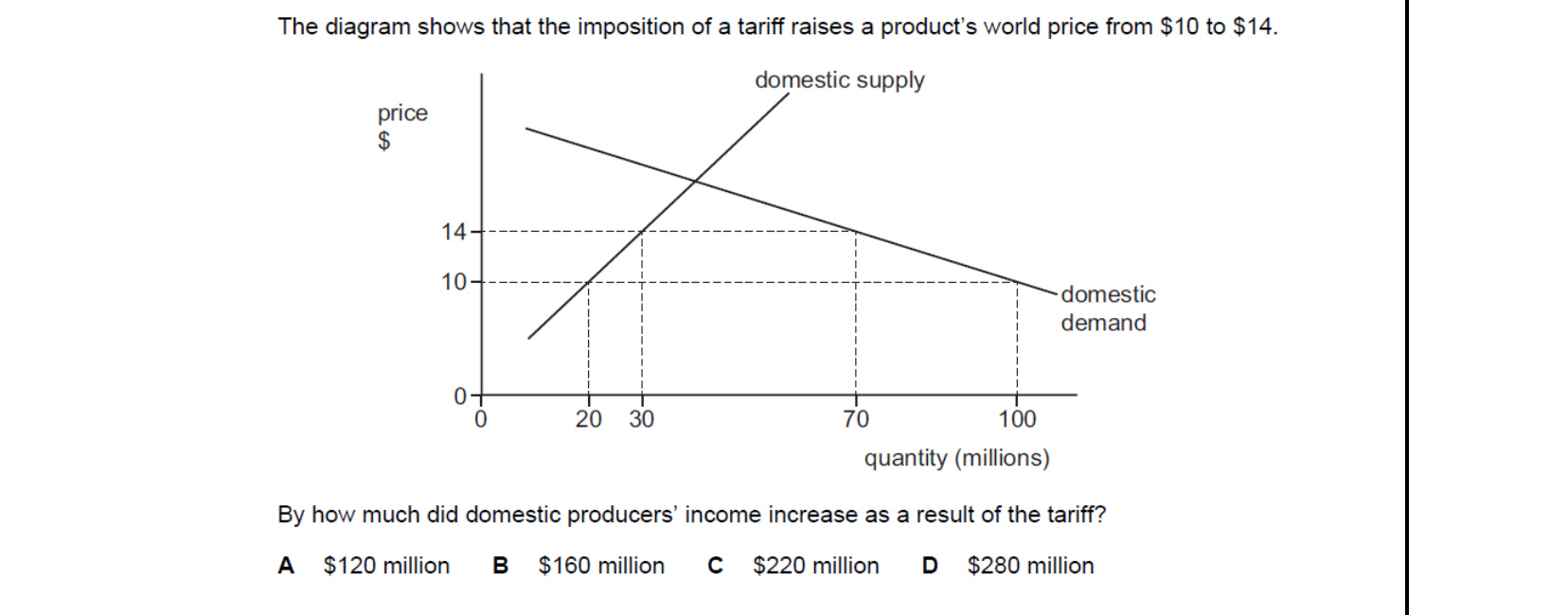
Producer revenue before the tariff is $10 × 20m = $200m. After the tariff, the higher price of $14 induces more domestic supply, to 30m units, so producer revenue is $14 × 30m = $420m. The increase in domestic producers' income is $420m − $200m = $220m, which matches option C.
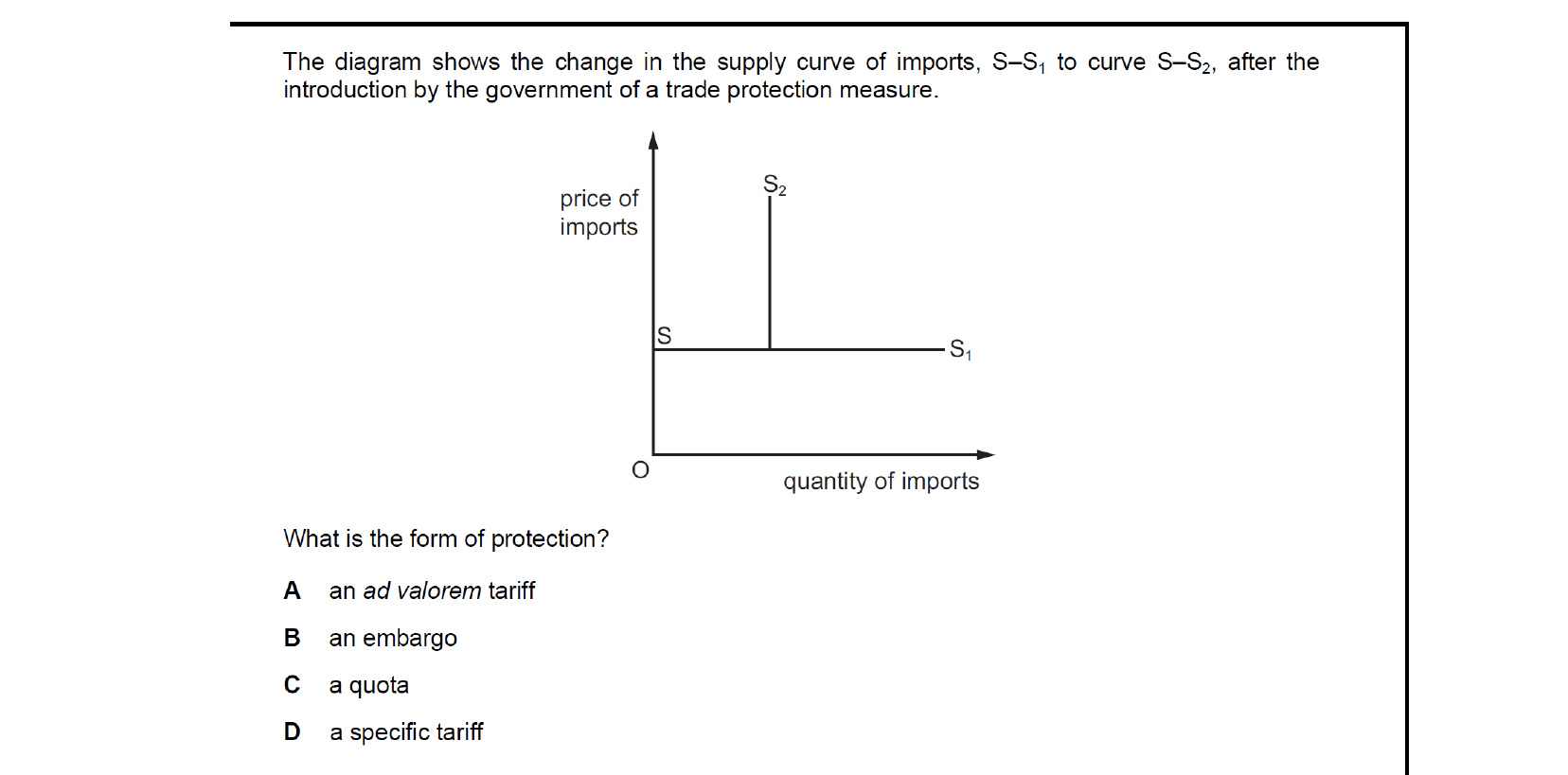
A quota appears on a supply-of-imports diagram as a vertical segment beyond a certain quantity — the import supply curve becomes vertical at the quota limit, because no more can be imported however high the price rises. That kink-and-vertical pattern matches the shift from S–S1 to S–S2 shown here. A tariff would shift the curve up parallel (specific) or pivot it (ad valorem), and an embargo cuts imports to zero.
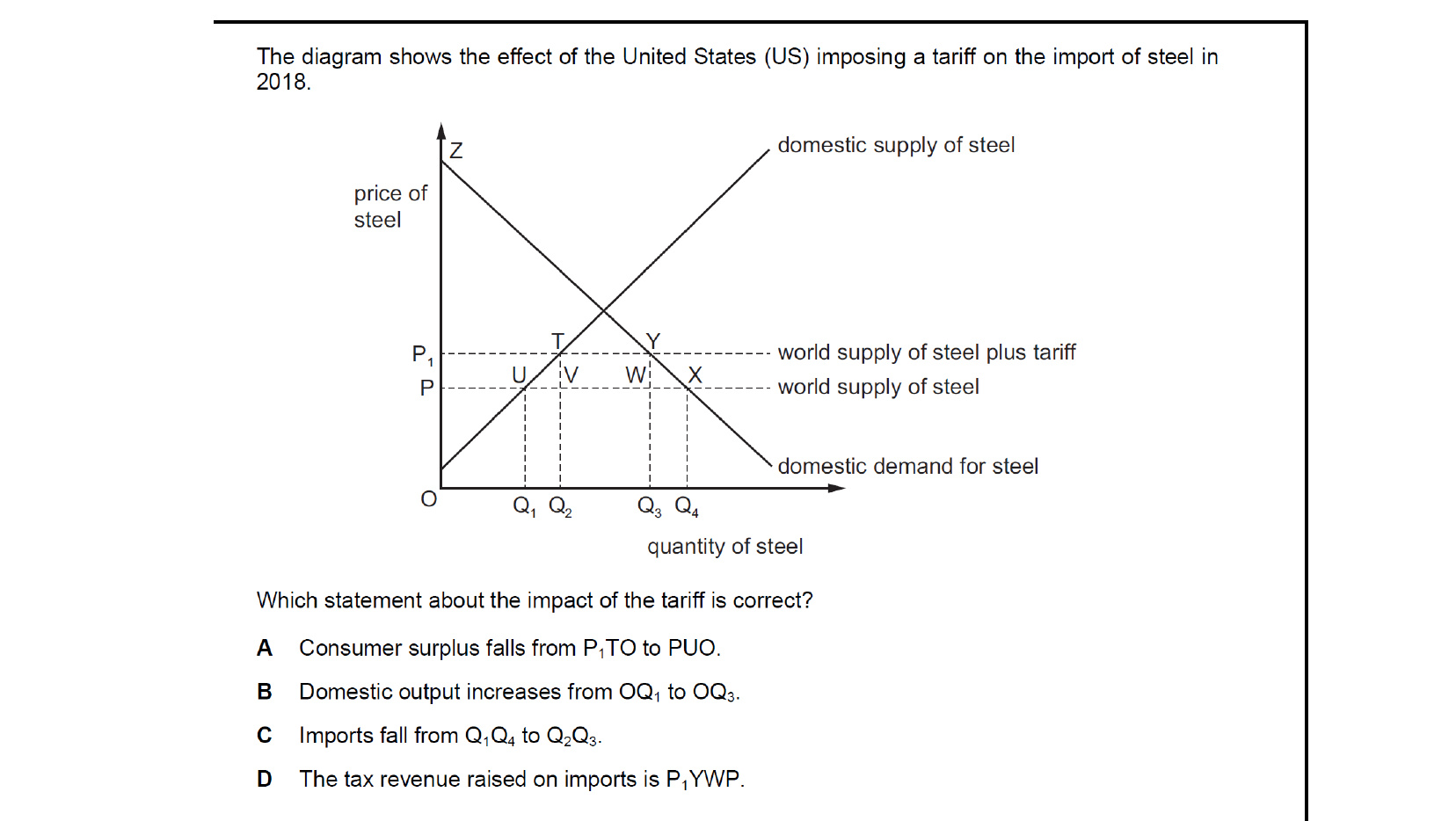
Before the tariff, imports fill the gap between domestic supply Q1 and domestic demand Q4 — so imports = Q1Q4. After the tariff raises the price to P1, domestic supply rises to Q2 and demand falls to Q3, so imports = Q2Q3. Imports therefore fall from Q1Q4 to Q2Q3, exactly as option C states.
26.3The arguments for protectionism
Despite the case for free trade, virtually every country uses some import restrictions. The main economic arguments for protectionism are: to protect infant industries; to protect declining industries; to protect strategic industries; to prevent dumping; to improve the terms of trade; to improve the balance of payments; and to provide protection from cheap labour. Tariffs may also be used simply to raise revenue.
To protect infant industries
Infant industries are new industries with low output and high average cost. Faced with competition from larger, more established foreign producers that already enjoy economies of scale and a recognised brand, an infant industry may not survive long enough to grow. Temporary protection (sometimes called sunrise-industry protection) can give the industry time to expand, exploit economies of scale and build a reputation, with the prospect that the country eventually gains a comparative advantage in the product.
The difficulty is identifying in advance which infant industries will succeed. Estimating an industry's long-run average cost curve is hard. There is also a danger that a protected infant industry never grows up: aware that rival imports are being made artificially expensive, the industry may feel no pressure to drive down its own costs.
To protect declining industries
Industries that have lost their comparative advantage (sunset industries) may shed jobs quickly if exposed to full foreign competition, leading to a sudden and large rise in unemployment. Phased protection that is gradually removed can spread the adjustment over time, allowing some workers to retire and others to move into different industries before the protection ends.
Again, the industry may resist the eventual removal of protection. Protecting one declining industry can also harm others. If a steel industry has lost its comparative advantage and is protected by tariffs, the country's car industry — which uses steel as an input — has to buy more expensive steel, raising its costs and making it less competitive at home and abroad.
To protect strategic industries
Some industries produce goods regarded as strategic — for example, weapons, fuel and food. Governments may not wish to depend on foreign supply of such products in case trade disputes or military conflict cut off supply. They may therefore protect strategic industries even when those industries are relatively inefficient.
To prevent dumping
Dumping is the sale of products in a foreign market at below their cost of production. It may be treated as unfair competition: in the short run home consumers enjoy lower prices, but if dumping drives domestic firms out of business the foreign firms may then gain a monopoly position and raise prices. Foreign firms may finance dumping out of past profits, by charging higher prices in their own markets, or with subsidies from their governments. The objective may be to capture a foreign market by destroying existing competition and discouraging new domestic entrants. In practice it can be difficult to distinguish dumping from a genuine foreign comparative advantage that simply makes the foreign firm a low-cost supplier.
To improve the terms of trade
If a country buys a large share of another country's exports of a product, it may be able to push down the product's price by restricting its own demand. Lower import prices relative to export prices improve the country's terms of trade and allow it to buy more imports per unit of exports. Similarly, a country that supplies a large share of world output of a product can use export quotas to drive up the price of that product. Both moves distort trade, may reduce global output and may invite retaliation.
To improve the balance of payments
A government may impose trade restrictions to improve its current account position. Tariffs that encourage consumers to switch from imports to domestic substitutes reduce import expenditure. The risk is retaliation: if foreign governments respond with their own trade restrictions, the country's exports may fall as well. International trade declines, global output contracts, and any improvement in the current account is offset. Where the underlying lack of competitiveness is structural, trade restrictions only provide a short-term boost.
To provide protection from cheap labour
Some argue that products from low-wage countries should face trade restrictions because otherwise wages and living standards in the importing country would have to fall to compete. The argument is weak. Low wages do not necessarily mean low unit labour costs: if labour productivity is also low, labour costs per unit of output may be high. Where low wages do reflect lower unit costs, they may indicate a genuine comparative advantage. There are moral arguments against imports produced with slave or child labour, but trade restrictions may not be the best response: they can drive wages in low-income countries even lower.
Other reasons
Tariffs may be used purely to raise tax revenue, which is most successful when demand for imports is inelastic. Trade restrictions can be used as a bargaining tool to persuade another government to reduce its own protection, although this carries the risk of escalating into a trade war. Governments may also restrict imports that they argue do not meet domestic health and safety standards; standards differ between countries, so what one country bans another may permit. Finally, a government may use protection to maintain a diversified industrial base and so reduce the risks of overspecialisation.
26.4The arguments against protectionism
Protection often fails to deliver on its objectives. Infant industries do not always grow up into efficient producers. More fundamentally, protectionism removes the benefits of free trade discussed in the previous chapter.
Protectionism may:
- prevent countries from specialising in the products in which they have a comparative advantage, lowering global output and living standards;
- reduce international competition and so allow domestic firms to raise prices and let product quality slip;
- reduce the choice of products available to consumers;
- shrink the size of firms' effective markets and so reduce their ability to exploit economies of scale;
- narrow the range of raw materials and capital goods available to firms, raising costs of production;
- provoke retaliation that escalates into a trade war, with tariffs pushing up prices on both sides.
The arguments for free trade are therefore, in effect, the arguments against protectionism, and the arguments for protectionism are the arguments against free trade. Whether protection is warranted in a specific case depends on the type of industry, the cause of the lack of competitiveness, and the likelihood that trading partners will respond with restrictions of their own.
An importer wants to win consumers' backing for free trade. Tariff revenue benefits the government, not consumers; terms-of-trade gains are abstract; and the employment argument is contested. The case that directly resonates with consumers is that more imports increase competition in the domestic market — pushing down prices, improving quality and broadening choice. That is the importer's strongest pro-consumer pitch.
End-of-chapter practice
Past-paper questions from CIE 9708. Pick A, B, C or D. Answers are saved on this device — press Download report (PDF) at the top to save them.
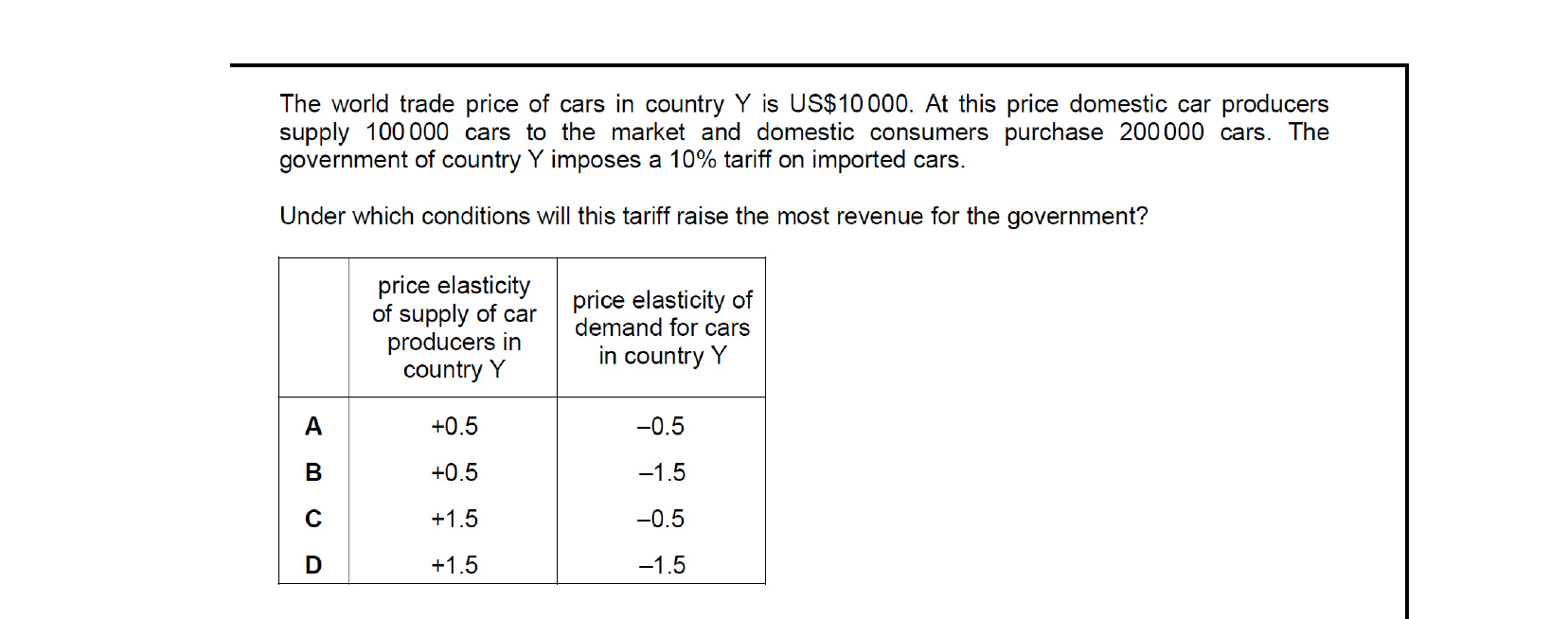
Tariff revenue = tariff × (imports after tariff). Imports = domestic demand − domestic supply at the new, higher price. Imports remain largest when domestic demand is least sensitive to the price rise (inelastic PED, e.g. −0.5) and domestic producers cannot easily replace imports (inelastic PES, e.g. +0.5). Both elasticities being inelastic preserves the volume of imports — and so the tariff revenue — most fully.
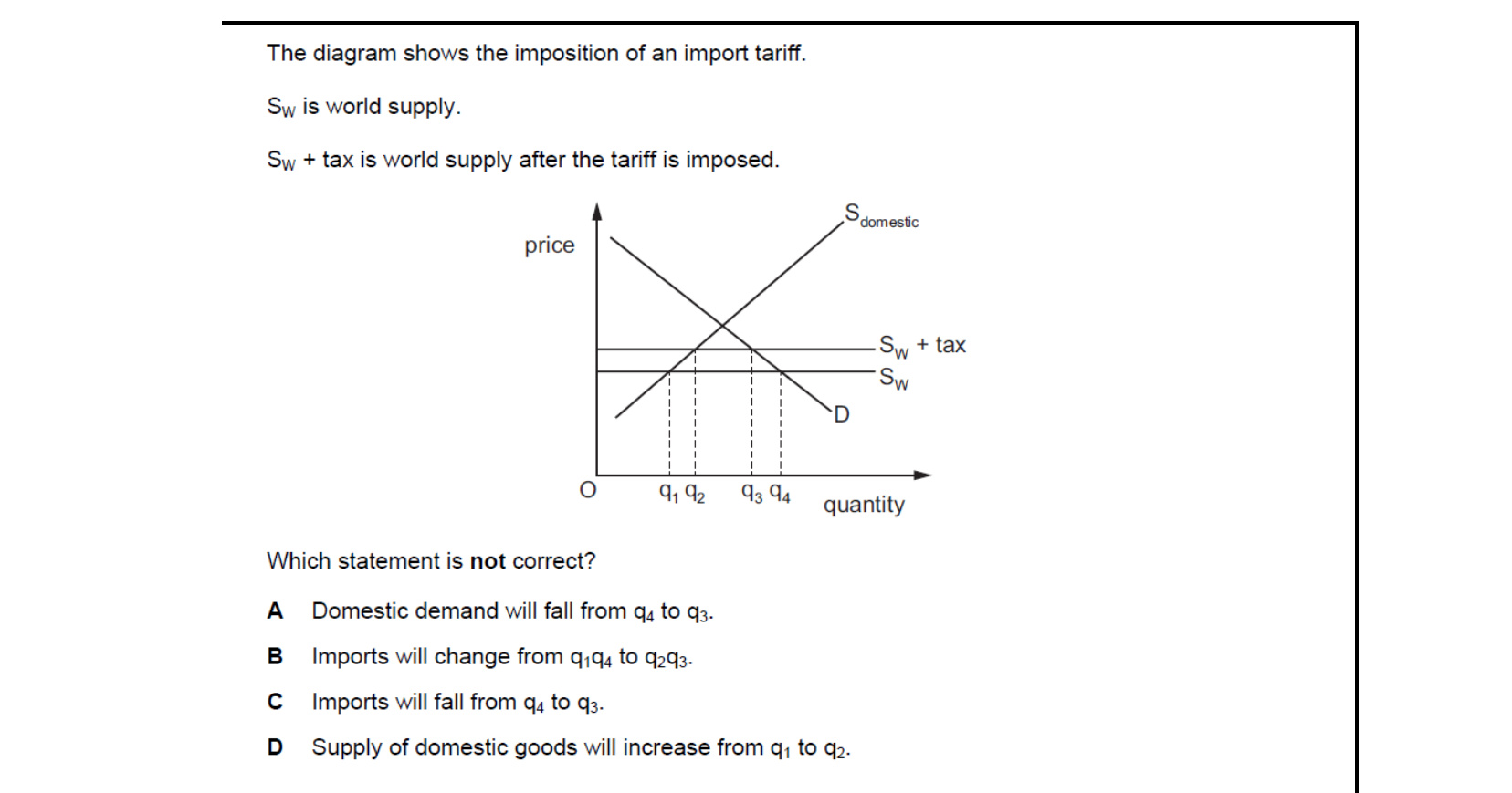
Reading the diagram: before the tariff, imports = q1q4 (the gap between domestic demand and domestic supply at the world price). After the tariff, imports = q2q3 (the smaller gap at the higher price). So domestic demand falls from q4 to q3 (A is correct), imports change from q1q4 to q2q3 (B is correct), and domestic supply rises from q1 to q2 (D is correct). The statement that imports fall from q1q4 to qs misreads the diagram and is the incorrect one.
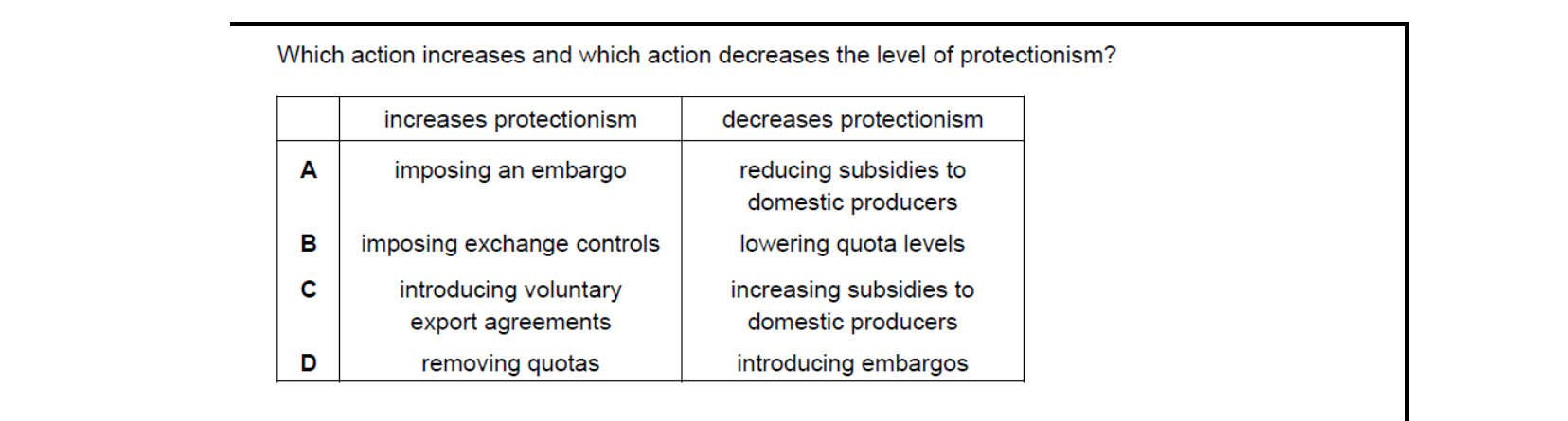
An embargo is a complete ban on imports — clearly increasing protection. Subsidies to domestic producers shield them from foreign competition, so reducing those subsidies lowers protection. Hence the pair 'impose an embargo / reduce subsidies to domestic producers' correctly identifies one action that increases and one that decreases protectionism, which matches option A.
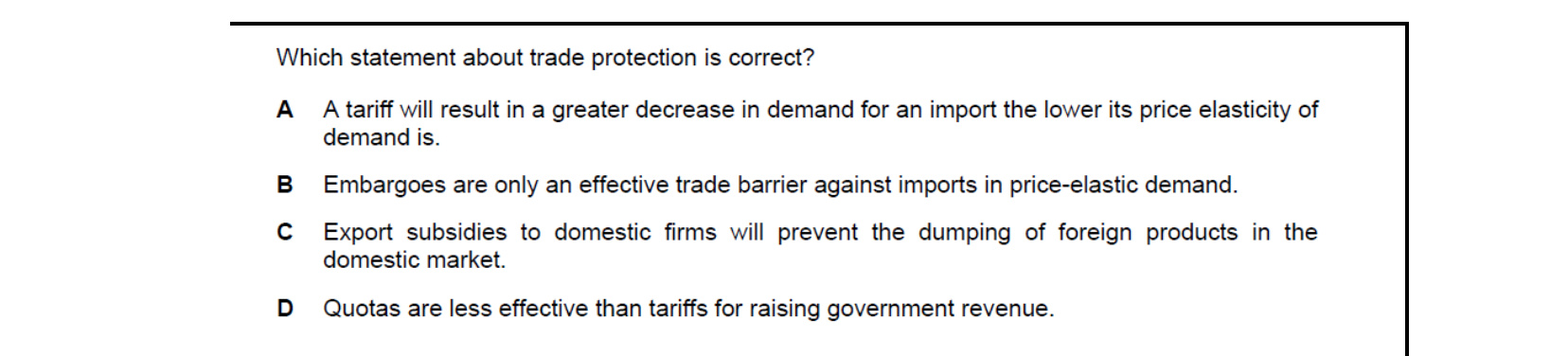
Tariffs directly generate revenue for the government — tariff × imports. Quotas restrict the volume of imports but the price premium that results typically goes to importers or foreign suppliers (unless quotas are auctioned), not the government. So quotas are less effective than tariffs for raising government revenue, which is precisely what option D says.
Attempt the practice questions above to build your score.
Self-evaluation checklist
After studying this chapter, you should be able to:
- Understand that protectionism is when governments seek to protect domestic industries from foreign competition
- Explain the impact of the tools governments use to protect their industries and restrict trade: tariffs, import quotas, export subsidies, embargoes, excessive administrative burdens ('red tape')
- Analyse the impact of the different tools of protection
- Discuss the arguments for and against protectionism
Want more practice? Drill this chapter's past-paper MCQs (79 questions) →